Gaming Always Puts Me in a Better Mood T‑Shirt: What to Know Before You Buy or Sell
There’s something about slipping on a t‑shirt that instantly lifts your spirits. For many, the phrase “Gaming Always Puts Me in a Better Mood” isn’t just a slogan – it’s a daily reminder that a few rounds of your favorite game can reset your mindset. But whether you’re a buyer looking for that perfect retro‑style gaming tee or a seller creating custom apparel for platforms like Amazon, Etsy, or Redbubble, there are several pitfalls that can turn that good mood sour. Let’s walk through the most common mistakes, what they cost you, and how to make choices that keep both your wallet and your wardrobe happy.
1. Overlooking the Difference Between Consumer and Creator Needs
One of the biggest misunderstandings about “Gaming Always Puts Me in a Better Mood” apparel is that the same product serves both the end‑user and the seller. In reality, a buyer cares about fabric feel, print durability, and sizing. A seller or small business owner cares about file quality, scalability, and licensing. Mixing these concerns leads to poor decisions on both sides.
How This Hurts Buyers
You might see a design you love on Etsy and assume the print on a 50/50 cotton‑polyester blend will last as long as the one on a premium 100% ringspun cotton tee. Without checking the garment details, you could end up with a faded, cracked print after a few washes. Always read the product description carefully – and if the listing only shows a mockup without specifying the shirt fabric, ask the seller before purchasing.
How This Hurts Sellers
If you’re a creator, using low‑resolution raster files (like 72 dpi JPEGs) for print‑on‑demand services will result in blurry, pixelated designs. That “Gaming Always Puts Me in a Better Mood” phrase deserves crisp vector shapes. The best designs are built with 100% vector elements that remain sharp at any size. Look for file packages that include AI, EPS 10, and SVG – these formats let you resize the art without losing quality.
2. Ignoring Print File Specifications
Mistake: Relying on a single PNG file and assuming it will work for every printing method and platform.
Each marketplace and printing process has its own requirements. A 4500×5400 pixel PNG at 300 dpi with a transparent background is excellent for screen printing and many direct‑to‑garment (DTG) services. But some sellers also need a layered vector file to adjust colors for different shirt colors or to tweak the design for stickers, posters, or mugs. If you only provide the PNG, you limit your product line.
Better approach: Choose a design package that gives you flexibility. The ideal set includes:
- A high‑resolution PNG (with transparent background, print‑ready at 300 dpi)
- Vector files (AI, EPS, SVG) that are fully editable
- A t‑shirt mockup to visualize the final product
- All files in a single ZIP for easy access
If you’re buying from a designer like Sourav, verify that the files meet these standards. That way, you’re not caught having to re‑purchase a separate vector version later.
3. Assuming One Design Fits Every Base Color
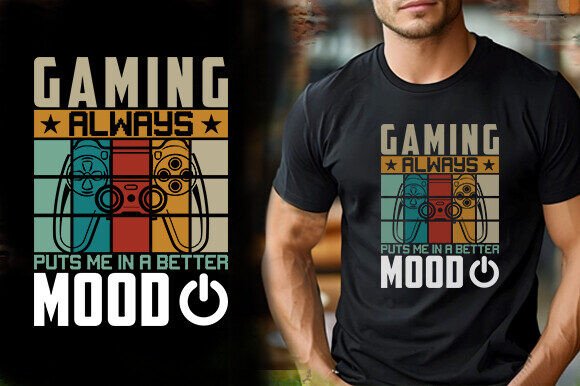
A “Gaming Always Puts Me in a Better Mood” design with bright neon letters may look perfect on a black tee but become completely unreadable on a white or pastel shirt. Yet many sellers upload the same art to multiple color variations without adjustment.
The consequence: Poor contrast leads to returns and negative reviews. Buyers receive a shirt where the slogan is barely visible, and they blame the seller – not the file.
How to avoid it: If you’re a seller, use vector files that allow you to easily change the color of the text and background elements. Look for designs that include an easily modifiable color palette. For example, invert dark text to light or add an outline layer. The best packages are described as “easy to modify and change color” – that’s a sign the designer prioritized versatility.
4. Skipping the Mockup Evaluation
We’ve all seen listings where the mockup clearly doesn’t match the actual print size or placement. A design that looks huge on a mockup may print tiny, or a centered graphic might shift to the side. This is especially common with “Gaming Always Puts Me in a Better Mood” tees that use custom typography; the phrase length can cause wrapping issues on smaller sizes.
What to check: Always examine the included mockup file. It should show the design on a realistic t‑shirt with proper proportions. If the mockup looks distorted or stretched, the final product likely will too. For creators, always test the design on multiple size templates (S through 3XL) before publishing.
5. Forgetting About the “Best Cheap” Trap
Many customers search for “cheap gaming t‑shirt” and end up with a product that feels more like a sandpaper bib than a soft garment. “Cheap” doesn’t have to mean low quality, but it often does when corners are cut on print materials or fabric.
Realistic example: A $12 shirt that uses a plastic‑like heat transfer vinyl might crack after the second wash, whereas a $20 shirt with a DTG print on 100% combed cotton will stay vibrant for years. The initial savings vanish when you have to replace the shirt within two months.
Better decision: Look for descriptions that mention “high quality with 300 dpi” and “ready to print” – these phrases indicate the design assets were created professionally. But also check the product’s actual garment specs. For sellers, pricing your shirt competitively matters, but don’t sacrifice the base quality. Offering a “best value” option with a slightly higher price point often leads to better reviews and repeat customers.
6. Overcomplicating the Buying Decision
When you see a phrase like “Gaming Always Puts Me in a Better Mood,” it’s easy to get caught up in whether the font is exactly right or if the retro style matches your aesthetic perfectly. While personal taste matters, don’t let analysis paralysis keep you from a shirt that makes you smile. The more important factors are:
- Print quality and longevity
- Garment material and fit
- Size range (especially for women’s cut vs. unisex)
- Return policy
If those are solid, the design itself will do its job: put you in a better mood.
7. Misunderstanding File Licensing for Resellers
Entrepreneurs who want to sell “Gaming Always Puts Me in a Better Mood” t‑shirts on Teespring or Redbubble often forget that buying a design file doesn’t automatically grant resell rights. Some designers include a commercial license in the purchase; others require an additional fee.
Consequence: Using a file without proper licensing can result in your listing being taken down or even legal action. It’s a headache that’s completely avoidable.
Advice: Before you buy, read the product description thoroughly. Sourav’s package, for instance, states it’s for printed t‑shirts, stickers, apparel, and more – but if you intend to sell the design itself (as digital files), you’ll need explicit permission. When in doubt, message the seller and ask directly.
8. Neglecting to Test the Vector Edits Before Printing
If you’re a creator who modifies the vector file – changing the phrase color, adding a border, or adjusting the layout – you must proof the edited file before submitting it to the printer. A small oversight like a missing letter or misaligned text can ruin an entire batch.
Practical step: Always export a new PNG at 300 dpi and view it at 100% zoom. Compare it with the original mockup. If the design seems off, revert your changes. The beauty of having editable AI and EPS files is that you can experiment risk‑free – but you still have to double‑check the final version.
9. Not Factoring in Shrinkage and Print Placement
Different fabrics shrink at different rates. A 100% cotton tee may shrink up to 5%, which can distort a large design that sits close to the hem. The “Gaming Always Puts Me in a Better Mood” slogan, if placed too low, might curl up awkwardly after the first hot wash.
Solution: For buyers, follow the care instructions (cold wash, low heat dry) to preserve both shirt and print. For sellers, consider leaving a small margin between the bottom of the design and the shirt hem, especially on women’s cuts where the shirt is shorter. A mockup that shows placement relative to the collar and sleeves is a good sign the designer has considered real‑world wear.
10. Believing a Single Design Fits Every Platform’s Guidelines
Amazon, Etsy, Teespring, and Redbubble each have different requirements for image resolution, file size, and even wording. A design that works perfectly on a Redbubble hoodie may need a different aspect ratio for Amazon’s listing images.
How to handle it: Use the “fully editable” vector files to create variations. The provided PNG (4500×5400 at 300 dpi) is a solid starting point, but you may need to crop it or add a bleed for specific products. Keep the original layered files so you can adapt without starting over.
Wrapping Up: Making the Right Choice for You
Whether you’re wearing a “Gaming Always Puts Me in a Better Mood” shirt because it genuinely brightens your day, or you’re creating and selling these designs as part of a print‑on‑demand business, the key is paying attention to what’s actually in the package and how it fits your needs. Avoid the traps of ignoring file formats, overlooking mockup realism, and assuming one size fits all – literally and figuratively.
Take a few extra minutes to verify the vector files are included, that they’re 100% scalable, and that the color can be changed effortlessly. Look for a high quality 300 dpi PNG with a transparent background, and don’t forget the mockup. These small steps transform a potentially disappointing purchase into a lasting favorite – or for sellers, into a reliable product that keeps customers coming back.
Gaming truly does put many of us in a better mood. With the right t‑shirt and the right approach, that mood can last through countless wash cycles and game nights.